

Why does my child ask for the same story again and again?
Understand requests for the same story, with research on repetition, word learning and practical ideas for family conversations.
When your child chooses yesterday's story instead of a new book, you may feel ready for a change. They may be returning to a familiar scene, a favourite sentence or an event they want to understand again. Treating the request as nothing more than habit can hide what changes during each encounter. The same story does not necessarily produce the same experience every time. A useful starting question is, “What are they interested in revisiting now?”
Finding a new detail in a familiar story
A child who followed the sequence of events on the first reading may notice a small object in the illustration next time. They may enjoy saying a character's line in advance or imitating the reader's voice. These are forms of participation families can observe. Repeating a sentence does not prove that a child understands the whole narrative, but it offers a way to discuss their connection with that part. Repetition can be observed without turning it into a test.
Horst, Parsons and Bryan found that repeating the same story context supported young children's learning and retention of new words [1]. The study used specially prepared books and particular tasks. Its findings should not be read as a recommendation for unlimited repetition of every story. How repetition is offered and what the child engages with remain important.
How research considers repetition
Flack, Field and Horst's meta-analysis examined word learning through shared storybook reading alongside factors including reading style and repetition [2]. This reminds us that counting different books does not fully describe an experience. Findings about learning particular words also do not establish effects on general intelligence or achievement across subjects. There is no need to justify rereading with broad promises about development.
In Turkey, Sağlam Durmaz and Özyürek reported associations between working memory and emergent literacy [3]. This separate study was not an intervention testing repeated reading. Families can consider learning processes as connected but distinct areas. A child's familiarity with a story is not a measure of their overall memory capacity. Asking for more details at every reading is not necessary either.
Share the same book in different ways
If a child chooses the familiar story, follow their interest in a favourite section. “Which page would you like to return to?” can be enough. Another day, you might leave a character's dialogue to them or tell the sequence together using the pictures. If they prefer just to listen, accept that too. Offering a different way to participate does not mean every rereading must become a new activity. Sometimes a child wants the familiar narrative told in the usual way.
An adult who is tired can state a calm boundary: “We can read this part together today and return to the rest tomorrow.” Responding to repetition does not require everyone in the family to listen to the same content continuously. You can keep another story available through a small choice of suitable options. Listening to the child's preference and maintaining daily routines can go together. Automatic playback should not replace a deliberate decision to revisit content.

Connect a story with a family memory
Conversation about repetition need not stay within a book. “We saw something like that the other day” can connect the narrative with a shared experience. Avoid putting a forgotten detail into the child's mouth. State your own recollection separately: “I remember this part.” Fivush, Haden and Reese's review discusses elaborative conversations about past experiences within families [4]. The practical suggestion here is to leave room for a child's personal account, rather than test their memory.
Mercan's story “Three Stories of the Same Day” can open a conversation about remembering different details of one experience. On one return to the story, a child might focus on who is telling it; on another, they may name their favourite detail. Moving to other activities in the Story Globally collection is optional. The shared narrative provides a context families can revisit on different days and in different ways, without completing every item.
Look for participation rather than a score
Notice what the child does while listening again. Do they return to a word, point to a detail or challenge something you say? Listening without speaking may also be their chosen form of participation. An adult's observation should not become a definite conclusion about ability. A request for repetition alone is not treated as a sign of a developmental problem; any wider difficulties need to be considered within daily life as a whole.
New stories and familiar narratives can both have a place in a family library. Alongside offering choices, review the suitability of content and its place in the day's routine. Story Globally collections can be explored according to a child's curiosity rather than worked through as a checklist. Returning to the same story may begin a new conversation. Listening without rushing is a useful first step towards noticing it.
References
- Horst, J. S., Parsons, K. L. & Bryan, N. M. (2011). Get the story straight: Contextual repetition promotes word learning from storybooks. Frontiers in Psychology, 2, 17. View source
- Flack, Z. M., Field, A. P. & Horst, J. S. (2018). The effects of shared storybook reading on word learning: A meta-analysis. Developmental Psychology, 54(7), 1334–1346. View source
- Sağlam Durmaz, C. & Özyürek, A. (2022). Okul öncesi çocuklarda çalışma belleği & erken okuryazarlık becerilerinin incelenmesi. Erken Çocukluk Çalışmaları Dergisi, 6(1), 82–101. View source
- Fivush, R., Haden, C. A. & Reese, E. (2006). Elaborating on elaborations: Role of maternal reminiscing style in cognitive and socioemotional development. Child Development, 77(6), 1568–1588. View source
Continue the topic with a story
Turn what you read into a story, a coloring page and a short chat with your child.
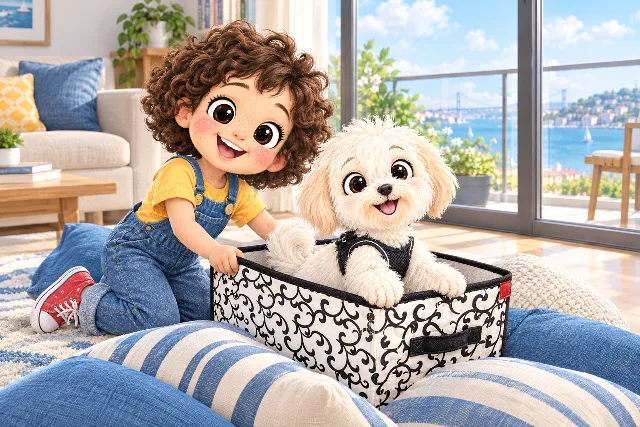
Carlos and the Box Boat — family set
Children see Carlos choose his torn box over a brand-new bed; they learn to read an animal's feelings from what it does, think about why an old, loved object matters, and discover …
Explore →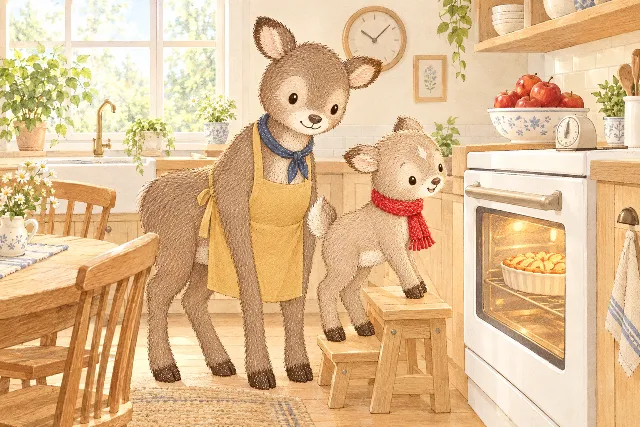
Riko and the Cake in the Oven — family set
Children bake a cake with Riko and his dad and notice that waiting is hard; when Riko gets bored, they see him find something to do (drawing a cake, building one from blocks) and k…
Explore →
Riko and the Kite That Waited for the Wind — family set
Children feel sad with Riko when his kite won't fly; they try putting the feeling into words, noticing the reason (no wind) and waiting patiently with Mum, and see Riko say "Come a…
Explore →