

My child does not want to listen to books: How can we begin reading together?
Research-informed ways to begin shared reading when a child does not want to listen, with small choices and responsive parental support.
If your child turns towards a toy as soon as you open a book, there is no need to write off shared reading. They may be tired, uninterested in that story or unwilling to participate in the way you expected. A useful first aim is to find a moment when the child can connect with the narrative. Looking at one page, pointing to a character or enjoying a sound together can all be part of that connection. Begin by trying to understand the response rather than judging it.
Find out what your child is resisting
“They don't like books” is a broad interpretation. A child might dislike sitting for a long time, hearing several unfamiliar words in a row or answering questions after every page. Observe different circumstances over a few encounters. When are they more comfortable? What changes when they choose the story? Do they listen while exploring the pictures? The answers offer a more useful starting point than trying to make the same child listen for longer.
NAEYC's developmentally appropriate practice framework considers individual characteristics and context alongside common patterns of development [1]. At home, you might choose a simpler scene, explain an unfamiliar word or keep the encounter short that day. These adjustments make the experience more accessible; they are not judgements about the child's ability. An arrangement that works for one child should not automatically be expected to suit another.
Offer a small, genuine choice
Instead of presenting an entire library, offer two stories you have already checked. “Shall we look at the seaside story or the garden story?” gives a concrete choice. Once the child chooses, you can begin with the first picture alone. Starting without a requirement to finish gives you room to observe participation. If neither story appeals, return another time. Reading need not become a negotiation over compliance.
Keep the opening invitation brief. After “What might have happened here?”, wait for a response. If the child points, name the detail. If they simply want to look, do not immediately add another question. Your voice, gestures and curiosity can offer a model, but every reading encounter need not become an elaborate performance. Shared reading is not an activity in which adults must deliver a perfect presentation.
Make room to listen as you tell
Ergül, Sarıca and Akoğlu's review of interactive reading emphasises listening to children, expanding their responses and explaining unfamiliar words [2]. If a child says “The cat's in the sea,” you could respond, “The cat has noticed something by the sea.” Then wait for their next contribution. You do not have to correct every phrase or immediately ask another question.
Dowdall and colleagues' meta-analysis reports positive language outcomes in shared picture book reading interventions [3]. The structured programmes reviewed do not guarantee the same outcome from every encounter at home. A practical suggestion is to make space for the child's contribution. If they describe a scene in their own way, first try to understand what they mean. You can later discuss the difference between information in the story and a possibility they have imagined.
Begin with a small encounter
For the first encounter, choose one scene. Look at the picture together, read a few sentences and notice the response. Continue if the child wants to; if their interest changes, you can stop there. They may bring up a remembered detail themselves next time. There is no need to check what they “learned yesterday.” This is a flexible suggestion for families to try in their own circumstances, rather than a programme with a fixed duration.
In the Mercan collection at Story Globally, the scene in “Mercan and the Sea Pocket” where a shell is noticed could provide a brief shared focus. If the child is curious about the shell, you might continue the narrative or follow their interest in another detail. You do not need to open every activity in the collection. Check the language and emotional intensity first, then respond to the child's actual participation.
Finishing is not the measure of a good beginning
Returning to a sentence, pointing to a character or responding to your comment are small, concrete observations. Notice them without comparisons with other children. On days when listening does not appeal, conversation can grow from a different shared experience. If communication difficulties persist across settings and significantly affect daily life, discuss them with a teacher and an appropriate professional. A response to a book alone is not enough to draw developmental conclusions.
Beginning to read together often means responding thoughtfully to what interests the child. You do not need to work through a narrative on their behalf or obtain every answer. Story Globally's activity collections can be one option for this shared experience. A page, a short conversation and the freedom to stop can offer a manageable beginning for family life.
References
- NAEYC (2020). Developmentally Appropriate Practice: A Position Statement. View source
- Ergül, C., Sarıca, A. D. & Akoğlu, G. (2016). Etkileşimli Kitap Okuma: Dil & Erken Okuryazarlık Becerilerinin Geliştirilmesinde Etkili Bir Yöntem. Ankara Üniversitesi Eğitim Bilimleri Fakültesi Özel Eğitim Dergisi, 17(2), 193–206. View source
- Dowdall, N., Melendez-Torres, G. J., Murray, L., Gardner, F., Hartford, L. & Cooper, P. J. (2020). Shared picture book reading interventions for child language development: A systematic review and meta-analysis. Child Development, 91(2), e383–e399. View source
Continue the topic with a story
Turn what you read into a story, a coloring page and a short chat with your child.
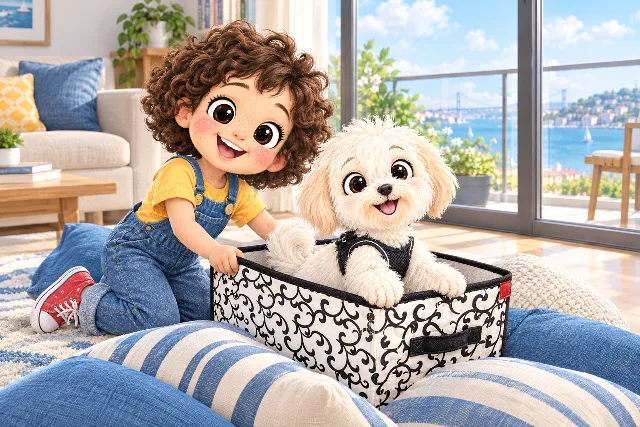
Carlos and the Box Boat — family set
Children see Carlos choose his torn box over a brand-new bed; they learn to read an animal's feelings from what it does, think about why an old, loved object matters, and discover …
Explore →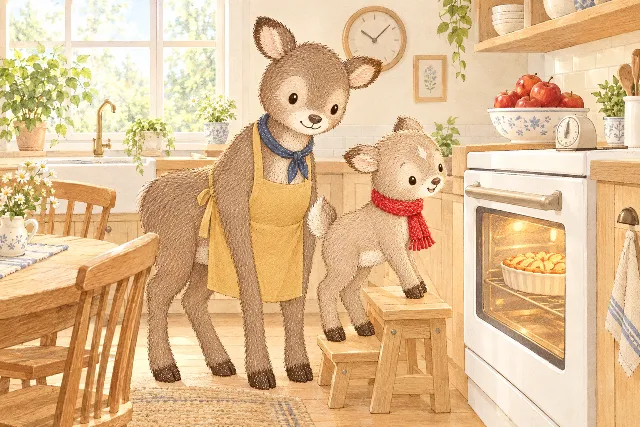
Riko and the Cake in the Oven — family set
Children bake a cake with Riko and his dad and notice that waiting is hard; when Riko gets bored, they see him find something to do (drawing a cake, building one from blocks) and k…
Explore →
Riko and the Kite That Waited for the Wind — family set
Children feel sad with Riko when his kite won't fly; they try putting the feeling into words, noticing the reason (no wind) and waiting patiently with Mum, and see Riko say "Come a…
Explore →