
How to use a story collection: Bringing reading, listening and discovery together
Explore StoryGlobally collections flexibly with shared reading, listening, colouring, puzzles and discovery, without a completion checklist.
Seeing books, colouring, puzzles and search activities on one collection page can raise the question, “Where should we begin?” Having several options does not mean they must all be completed in order. A story collection offers different ways to participate around a familiar character and narrative. For families, it is useful to notice what interests the child that day and offer support where needed. Conversation between experiences matters alongside the number of items available.
Check what is actually included
Review each Story Globally collection's description and available activities. Some sets contain several stories; narration or video may not be included in the same way everywhere. Do not choose by the cover alone. Get a sense of the age information, subject and language. Looking at a sample scene beforehand can help you understand how the narrative develops. You do not need to use the collection's entire contents in the first encounter.
Begin with a story that interests the child, or with colouring a familiar picture if that is what they prefer. Keep the purpose understandable. “Let's look at this character today, then talk about which detail interests you” offers a starting invitation. Choose an approach that fits family circumstances rather than imposing one correct sequence.
Make the shared narrative visible
Listening as an adult matters alongside reading aloud. Ergül, Sarıca and Akoğlu discuss children's contributions and expanded responses in interactive reading [1]. If a child wants to pause at a scene, listen to their question. A question after every page is unnecessary. When choosing narration, observe what the child engages with; reaching the end of an audio file alone does not demonstrate understanding.
You can discuss a detail across different items: “Where did we see this object in the story?” If the child does not recall it, revisit the picture together without making remembering compulsory. A familiar character provides opportunities for conversation, not an automatic developmental effect across all abilities. The child's actual interpretation and participation can help adults reconsider their expectations.
Listen to the approach used in puzzles and search activities
A puzzle piece's orientation or a neighbouring line may offer a cue. Levine and colleagues reported an observational association between early puzzle experience and spatial transformation [2]. This is not evidence for an effect specific to digital puzzles. “How did you decide where that might fit?” opens a conversation about strategy. Timing the task or requiring every piece to be placed is not necessary.
In a search picture, first make the target clear. If the child confuses similar details, beginning with a smaller part of the scene may be an option. Suggest an approach rather than immediately pointing to the object. Difficulty depends on more than the number of targets; visual complexity and understanding of the instruction also matter. These are practical family suggestions, not a programme measuring the platform's developmental effects.
Treat colouring as a form of expression
Ask what the child intended when choosing a colour. Instead of insisting that the sea must be blue, try “What sort of scene did you imagine with this colour?” If they do not want to explain, the work can remain their own creation. Pinto and Incognito examine associations between drawing, emergent writing and visual-motor integration [3]. Their study does not establish digital colouring as the same experience as handling a pencil.
On-screen colouring can suggest a conversation or an experience with physical materials, but a finished object is not required. Discussing a few colour decisions is another possibility. Avoid directing every choice towards an adult-preferred result. Leaving room for the child's account preserves different ways to participate. A finished picture should not be used to diagnose personality or emotions.
Allow flexible use across different days
Choose a story one day and a visual activity another. A child may want to return to the same narrative or explore another collection. Skene and colleagues' guided play review considers adult support and children's choices together [4]. Our suggested family approach draws on that framework; it is not a collection programme tested in those studies. The same outcome should not be assumed for every experience.
Mercan's stories about family memories and different perspectives may provide a starting point for recounting an everyday event together. Each person can name a remembered detail without drawing or taking photographs. Use Story Globally's Workshop content with this flexibility. A collection's value is not limited to completion counts: consider curiosity, the adult's response and the freedom to stop together.
References
- Ergül, C., Sarıca, A. D. & Akoğlu, G. (2016). Etkileşimli Kitap Okuma: Dil & Erken Okuryazarlık Becerilerinin Geliştirilmesinde Etkili Bir Yöntem. Ankara Üniversitesi Eğitim Bilimleri Fakültesi Özel Eğitim Dergisi, 17(2), 193–206. View source
- Levine, S. C., Ratliff, K. R., Huttenlocher, J. & Cannon, J. (2012). Early puzzle play: A predictor of preschoolers’ spatial transformation skill. Developmental Psychology, 48(2), 530–542. View source
- Pinto, G. & Incognito, O. (2022). The relationship between emergent drawing, emergent writing, and visual-motor integration in preschool children. Infant and Child Development, 31(2), e2284. View source
- Skene, K., O’Farrelly, C. M., Byrne, E. M., Kirby, N., Stevens, E. C. & Ramchandani, P. G. (2022). Can guidance during play enhance children’s learning and development in educational contexts? A systematic review and meta-analysis. Child Development, 93(4), 1162–1180. View source
Continue the topic with a story
Turn what you read into a story, a coloring page and a short chat with your child.
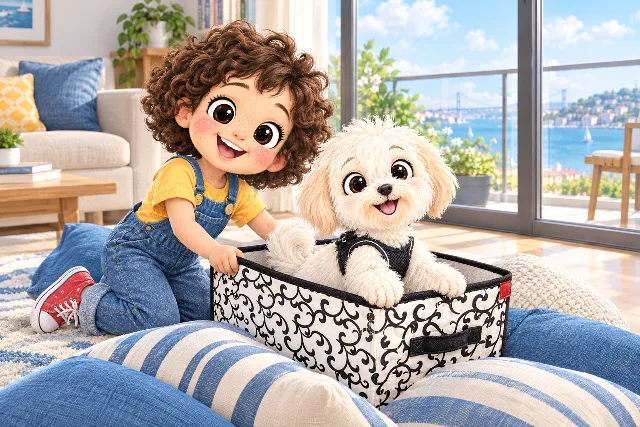
Carlos and the Box Boat — family set
Children see Carlos choose his torn box over a brand-new bed; they learn to read an animal's feelings from what it does, think about why an old, loved object matters, and discover …
Explore →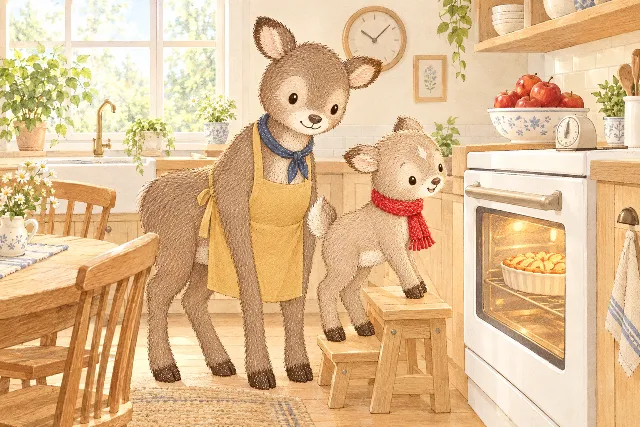
Riko and the Cake in the Oven — family set
Children bake a cake with Riko and his dad and notice that waiting is hard; when Riko gets bored, they see him find something to do (drawing a cake, building one from blocks) and k…
Explore →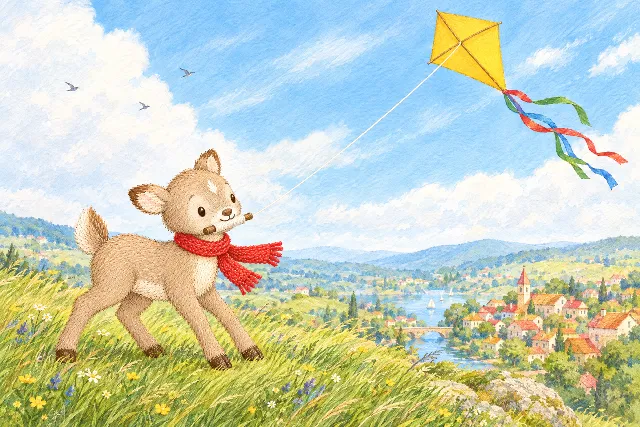
Riko and the Kite That Waited for the Wind — family set
Children feel sad with Riko when his kite won't fly; they try putting the feeling into words, noticing the reason (no wind) and waiting patiently with Mum, and see Riko say "Come a…
Explore →