

Family activities without preparation: Small discoveries inspired by a story
Small family discoveries inspired by stories, with no materials or preparation: shared memories, observation and everyday conversation.
Doing something together does not always require materials, a prepared table or a finished object. Recalling a shared event or noticing a detail outside the window can be enough to begin. Stories can provide subjects for these small encounters. An activity without preparation is not a way to keep giving children tasks to fill the day. It is an opportunity to respond to curiosity within ordinary life. Choose one suggestion when it fits rather than complete the list.
Choose one subject from the story
Do not try to apply every idea in a narrative on the same day. An interesting object, a character's choice or different accounts of an event can start a conversation. “Where have we seen something like that in our day?” is an invitation. If the child makes no connection, do not insist. Adults can share an observation without requiring the child's answer to reach the expected conclusion. A shared encounter can remain brief and return later.
Skene and colleagues' review of guided play considers adult support alongside children's scope for choice [1]. The suggestions here are not a home programme tested in those studies. We draw on the framework to leave room for contribution. The adult offers a starting invitation and the child can change its direction. A conversation of a few sentences need not become a learning session with a fixed length.
One day, two accounts
At a meal or on the way home, choose an ordinary moment you shared. Invite the child to name a remembered detail, then offer your own. “You noticed that; I remember something else” recognises both accounts. Do not compete over who remembers correctly. If a detail is uncertain, say so. Avoid leading a child to complete an event they do not recall.
Fivush, Haden and Reese discuss elaborative family conversations about past experiences within cognitive and socioemotional development [2]. Our practical suggestion leaves room for a personal account. Mercan's “Three Stories of the Same Day” also provides a starting point for remembering different details. Reopening the book, drawing or recording the memory is not required. If the child does not want to tell an experience, leave the conversation for another subject.
Discover without touching
On a walk or looking through a window, choose a natural detail at a safe distance. It might be tree bark, a leaf or a distant bird. Discuss what you can actually see and what you are guessing. The child can describe a shape, and the adult can add another observation. Approaching wildlife, collecting objects or moving them is unnecessary. Skip the suggestion if there is no suitable opportunity; a special outing is not required.
In “Mercan and the Sea Pocket,” a shell is left in place because it might contain a living creature. You can connect a daily discovery with that scene. Asking how the child would remember an object does not require a drawing task. Describing a sound, naming a colour or simply looking can be a shared experience. Follow the child's question without turning every encounter into an extended environmental lesson.

Listen to another person's choice
While looking at a scene together, each person can name a favourite detail. Then ask whether anyone else noticed it. People need not choose the same thing. If the child points, an adult can put the contribution into words. This can be a brief conversation at a meal or during a journey. Choose a safe, calm moment; the exchange must not take an adult's attention away from driving or another responsibility.
Turkey's 2024 Ministry of National Education preschool programme considers family participation across home and school experiences [3]. It is not an official endorsement of these suggestions. It provides context for thinking about family participation in Turkey. Look for the value of daily discoveries in an exchange where adults listen and respond to children. The number of times a task is completed does not establish its quality.
Keep the suggestions manageable
Using few materials matters, but avoiding obligations matters too. Families need not ask a question every day, record answers or share results. Some days are busy. Stop when the child or adult has had enough. Another encounter may follow on a later day; if it does not, that does not cancel the value of the earlier moment. Suggestions can remain options that fit the family's routine.
When using Story Globally collections, take one subject from a story into an off-screen conversation. A daily discovery does not require opening more content. A shared memory, detail or different viewpoint can be enough to begin. Listening to a child's actual question and offering your own contribution creates small opportunities for family participation within everyday life.
References
- Skene, K., O’Farrelly, C. M., Byrne, E. M., Kirby, N., Stevens, E. C. & Ramchandani, P. G. (2022). Can guidance during play enhance children’s learning and development in educational contexts? A systematic review and meta-analysis. Child Development, 93(4), 1162–1180. View source
- Fivush, R., Haden, C. A. & Reese, E. (2006). Elaborating on elaborations: Role of maternal reminiscing style in cognitive and socioemotional development. Child Development, 77(6), 1568–1588. View source
- Millî Eğitim Bakanlığı (2024). Türkiye Yüzyılı Maarif Modeli Okul Öncesi Eğitim Programı. View source
Continue the topic with a story
Turn what you read into a story, a coloring page and a short chat with your child.

Carlos and the Box Boat — family set
Children see Carlos choose his torn box over a brand-new bed; they learn to read an animal's feelings from what it does, think about why an old, loved object matters, and discover …
Explore →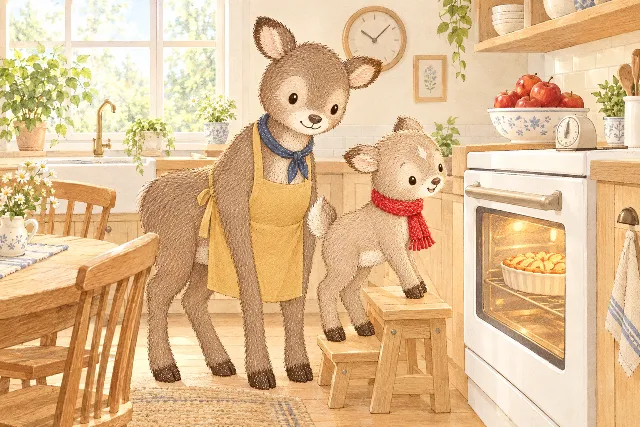
Riko and the Cake in the Oven — family set
Children bake a cake with Riko and his dad and notice that waiting is hard; when Riko gets bored, they see him find something to do (drawing a cake, building one from blocks) and k…
Explore →
Riko and the Kite That Waited for the Wind — family set
Children feel sad with Riko when his kite won't fly; they try putting the feeling into words, noticing the reason (no wind) and waiting patiently with Mum, and see Riko say "Come a…
Explore →